
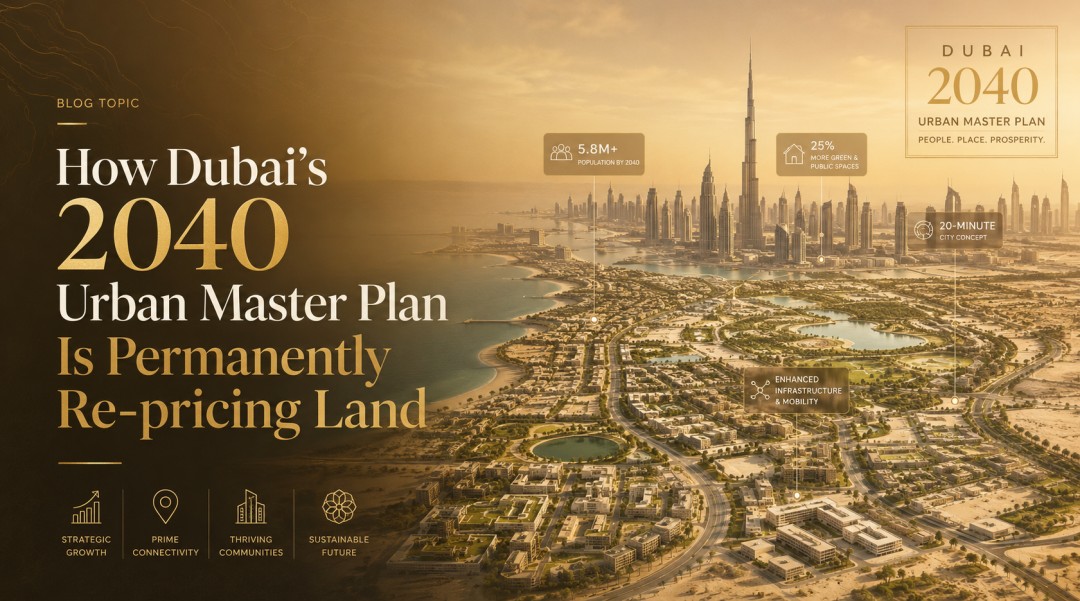
How Dubai's 2040 Urban Master Plan Is Permanently Repricing Land
1. The Paradox of Engineered Scarcity
Dubai's 2040 Urban Master Plan creates a dynamic that most land markets never experience: simultaneous mandated demand expansion and state-enforced supply contraction. Understanding this mechanism is the foundation for every capital allocation decision in this market.
- 5.8M — Mandated resident population by 2040
- 60% — Total emirate land locked as protected reserve
- 2× — Population growth required from current base
- 5 — Designated urban growth hubs
When 60% of land is permanently protected and population is legally mandated to nearly double, the arithmetic for remaining developable land is unambiguous. Supply is capped. Demand is government-guaranteed. The plots sitting inside the five designated urban hubs are not simply well-located real estate — they are the only legally permissible location for Dubai's next chapter of urban development.
For developers and investors who understand this dynamic, the question is not whether to allocate capital to Dubai land. The question is which zones, at what basis, and with what timing.
2. The Five Urban Hubs — and Where Land Value Is Concentrating
The 2040 Plan's most consequential structural shift is the concentration of all future urban density into five self-sustaining hubs. The objective is a '20-minute city' — where 80% of residents' daily needs are met within a 20-minute radius of their home. For land investors, the implication is direct: plots inside these boundaries carry structural premiums over all other locations. Plots outside them face long-term demand erosion.
| Urban Hub | Character & Economic Role | Primary Land Use | Investment Thesis |
|---|---|---|---|
| Deira & Bur Dubai | Historical and cultural core — heritage-led regeneration and residential densification | Mixed-use residential, boutique hospitality, community retail | Rezoning uplift as heritage corridors attract premium residential demand |
| Downtown & Business Bay | The financial and corporate engine — CBD expansion and DIFC ecosystem growth | Grade-A commercial, ultra-luxury residential, branded hotel | Supply-constrained CBD corridor — lowest available plot inventory vs demand |
| Dubai Marina & JBR | International tourism and hospitality anchor — global leisure destination | Waterfront hospitality, luxury residential, destination retail | Beachfront scarcity premium — near-zero available plot supply |
| Expo City Dubai | Global logistics, exhibition, and innovation hub — D33 gateway | Mixed-use hospitality, logistics, residential, MICE facilities | Strongest current price-to-trajectory gap — best risk-adjusted entry now |
| Dubai Silicon Oasis | Knowledge, technology, and digital economy cluster — free zone advantage | Tech office, mixed-use commercial, mid-density residential | 100% foreign ownership, zero corporation tax — institutional-grade free zone |
The Highest-Conviction Zone: Expo City and Silicon Oasis
Within the five hubs, Expo City Dubai and Dubai Silicon Oasis currently offer the most asymmetric risk/return profile for land investors. Both zones are in the phase of active infrastructure deployment — roads, utilities, Metro connections, and anchor tenants are being committed now, before population density has fully matured. This is the classic infrastructure-ahead-of-demand entry window that produces the highest annualised land appreciation in master-planned markets.
Land acquired today in these two corridors carries an emerging-market basis that will reprice to institutional-grade premiums as the 2040 Plan's density mandate is executed. The entry window is not indefinite — institutional developers are already active in both zones, and available supply is contracting.
3. Where to Deploy Capital: Asset Class Decision Matrix
Location within a designated hub is necessary but not sufficient for optimal returns. The choice of asset class — residential, commercial, hospitality, or industrial — determines the risk/return profile of the land within that location. The 2040 Plan creates materially different value trajectories for each.
| Asset Class | 2040 Plan Catalyst | Current Pricing Status | Upside Trajectory | Entry Urgency |
|---|---|---|---|---|
| Residential (Prime Hub) | Population mandate — 5.8M residents require housing supply | Fully priced | Moderate — already reflects scarcity premium | Medium |
| Commercial / Office | Corporate relocation wave + DIFC/ADGM ecosystem expansion | Attractively priced vs demand | High — Grade-A office supply deficit | High |
| Hospitality / Hotel | 134% tourism expansion target — 25M visitors by 2025 | Structurally underpriced | Very high — RevPAR outperforming global benchmarks | Immediate |
| Industrial / Logistics | 1.7 billion sq.ft. industrial mandate — Al Maktoum Airport | Discounted to intrinsic value | Very high — airport expansion is a 20-year demand driver | Immediate |
| Mixed-Use (Hub Transition) | Density consolidation into five hubs drives mixed-use demand | Transitional pricing — window open | High — transition zones re-price fastest as hubs mature | High |
The Core Asymmetry — Why Commercial and Hospitality Land Outperform
Residential land near established hubs already commands premium pricing with compressed upside — the scarcity premium is priced in. Commercial, hospitality, and industrial land in designated growth corridors, by contrast, offers a current discount to intrinsic value paired with identical or superior appreciation trajectories.
The mechanism is simple: residential demand is visible and widely understood; commercial, hospitality, and logistics demand from the 2040 Plan's structural mandates is less widely priced by the market.
The Asymmetric Opportunity:
Hospitality-zoned plots adjacent to Expo City are structurally underpriced relative to their post-2027 earnings potential. The 134% tourism expansion target and Al Maktoum International Airport's transformation into the world's largest cargo hub create a decade-long demand driver that is not yet reflected in current land pricing. The entry window is now, before institutional developers absorb available supply.
4. The Acquisition Timing Framework
Understanding the macro opportunity is the first step. Timing the acquisition correctly within it is where returns are made or lost. The 2040 Plan creates a series of predictable value inflection points tied to infrastructure milestones — each one a catalyst that reprices adjacent land. The optimal entry is always ahead of the catalyst, never after.
| Phase | Timeframe | Key Infrastructure Catalysts | Land Pricing Stage | Investor Action |
|---|---|---|---|---|
| Entry Window | Now → 2026 | Metro Blue Line groundwork, Al Maktoum Airport Phase 1, Expo City legacy district activation | Pre-catalyst pricing — current discount to intrinsic value | Acquire in Expo City, Silicon Oasis, Dubai South corridors |
| Re-pricing Phase | 2026 → 2029 | Metro Blue Line opens, Airport Phase 2 operationalises, MBR City density matures | Infrastructure premium begins to be reflected in pricing | Hold acquired positions; selectively add in Downtown transition zones |
| Maturity Phase | 2029 → 2035 | Full metro connectivity, 4M+ resident population, Expo City fully activated | Full institutional-grade premium pricing — exit opportunity for early investors | Harvest: exit residential and mixed-use positions; retain commercial/hotel for income |
| Long Hold | 2035 → 2040+ | 5.8M population mandate achieved; protected land buffer fully enforced | Peak scarcity pricing — highest per-sqft values in emirate history | Core hold for capital preservation; engineered scarcity maintains floor |
5. Key Questions Developers and Investors Are Asking
Q: Which areas in Dubai will appreciate most under the 2040 Master Plan?
The five designated urban hubs — Deira & Bur Dubai, Downtown & Business Bay, Dubai Marina & JBR, Expo City Dubai, and Dubai Silicon Oasis — will appreciate most, as all future density is concentrated within their boundaries. Within these hubs, Expo City Dubai and Dubai Silicon Oasis currently offer the best risk-adjusted entry pricing, as infrastructure deployment is underway but density has not yet fully matured. Hospitality and industrial-adjacent plots in these two zones offer the widest gap between current pricing and intrinsic value.
Q: Is commercial or residential land a better investment in Dubai right now?
For investors seeking the highest upside relative to current pricing, commercial, hospitality, and industrial land in designated 2040 hub corridors offers superior return potential compared to residential land in established communities. Residential land near prime hubs is already fully priced for the scarcity premium. Commercial, hospitality, and logistics land in growth corridors carries a current pricing discount while offering identical or superior appreciation trajectories driven by the 2040 Plan's structural demand mandates.
Q: What is the minimum plot size for development in Dubai's growth hubs?
Minimum plot sizes vary by zone and asset class. In designated commercial and mixed-use zones within Expo City and Silicon Oasis, plots typically range from 5,000 to 50,000+ sq.ft. for commercial and hospitality developments. Residential plots in master communities range from 4,000 sq.ft. (villa) to multi-acre compound sites. GFA allowances — which determine maximum buildable area — are zone-specific and materially impact development value. Lands & Co. provides full zoning and GFA data on every listing.
Q: Can foreign investors buy land in Dubai's designated growth zones?
Yes. Dubai's designated freehold zones — which include the majority of plots within the five 2040 urban hubs — allow 100% foreign ownership with DLD-registered title deeds. Free zone areas including Dubai Silicon Oasis and Expo City Dubai additionally offer 100% foreign ownership of companies, zero corporation tax, and simplified business licensing. A freehold land purchase of AED 2 million or above also qualifies the purchaser for UAE's 10-year Golden Visa.
6. The Lands & Co. Advantage: Access, Structure, Timing
Identifying the opportunity is the first step. Accessing, structuring, and timing capital correctly within it is where the return is made. Lands & Co. operates at the intersection of all three.
Pre-Market Access
Our deals are originated through Tier-1 developer relationships and private landowner networks — not public listing portals. The best plots in Dubai's growth corridors are transacted before they appear on Bayut or Property Finder. Our clients buy first.
Regulatory Timing Intelligence
We position capital against confirmed zoning catalysts — Metro line approvals, airport expansion phases, master developer NOC milestones — before the price moves. Our team monitors the regulatory pipeline continuously so our clients act on intelligence, not reaction.
End-to-End Deal Structuring
From single-plot acquisition to complex JV architectures and multi-phase development structuring, Lands & Co. executes the full transaction lifecycle. Acquisition mandate, JV negotiation, DLD transfer, development finance introduction, and project launch advisory under one roof.
DLD-Benchmarked Pricing
Every plot presented to our clients is validated against recent Dubai Land Department transaction records. You pay market price or below it — never above. Our pricing intelligence prevents the overpayment that erodes development margins.
13+ Years & AED 7.8 Billion
Our mandate track record represents real transactions, real developers, and real returns across Dubai's most consequential development cycles. We have been in this market through every phase — and we know which signals to trust.
The Window Is Open. It Will Not Stay Open.
The 2040 Urban Master Plan has engineered a supply constraint that cannot be undone. Five hubs. 5.8 million mandated residents. 60% of all land permanently protected. Institutional developers are already active in Expo City, Silicon Oasis, and Dubai South. The pre-catalyst pricing window is open now — and it closes as supply is absorbed.
Request Your Acquisition Briefing
Speak with the Lands & Co. investment team for a confidential briefing on available plots in Dubai’s 2040 growth corridors. Off-market access. Move before the market moves.
Contact Us: